All-attosecond pump-probe spectroscopy

An international team of researchers from the Max Born Institute in Berlin, University College London and ELI-ALPS in Szeged, Hungary, has demonstrated attosecond-pump attosecond-probe spectroscopy to study non-linear multi-photon ionization of atoms. The obtained results provide insights into one of the most fundamental processes in non-linear optics. The detailed experimental and theoretical results have been published in Optica.

Femtosecond (1 femtosecond = 10-15 seconds) pump-probe spectroscopy has revolutionized the understanding of extremely fast processes. For instance, the dissociation of a molecule can be initiated by a femtosecond laser pump pulse, and can then be observed in real time using a time-delayed femtosecond probe pulse. The probe pulse interrogates the evolving state of the molecule at different time delays, making it possible to record a movie of the molecular dissociation. This powerful technique was awarded with the Nobel Prize in Chemistry in 1999.

Some processes in nature, however, are even faster and take place on attosecond timescales (1 attosecond = 10-18 seconds). It would therefore be ideal to initiate an ultrafast process using an attosecond pump pulse, and to interrogate the system under investigation using an attosecond probe pulse. So far, attosecond-pump attosecond-probe spectroscopy has been demonstrated for relatively simple processes involving the absorption of two photons. However, since all-attosecond pump-probe spectroscopy is very challenging, most experiments in attosecond science use only one attosecond (pump or probe) pulse in combination with one femtosecond pulse.

The researchers have now been able to demonstrate a pump-probe experiment, in which complex multi-photon ionization processes were studied using two attosecond pulse trains. This experiment required the generation of very intense attosecond pulses, for which a large laser system was used. Consequently, the researchers performed the experiment in the largest laboratory that is available at the Max Born Institute. At the same time, the two attosecond pulses had to be overlapped with attosecond temporal and nanometer spatial stability. This explains why these experiments are so challenging.

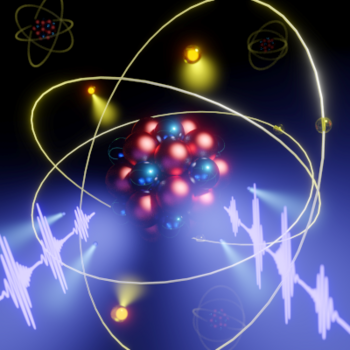
An artistic visualization of the experiment is presented in Fig. 1, showing two attosecond pulse trains interacting with an argon atom. Following the absorption of four photons from the attosecond pulses, three electrons were removed from the atom. There are many possible ways in which this multi-photon absorption may take place. To find out in detail how the electrons were removed from the atom, the researchers varied the time delay between the two attosecond pulses and observed how many ions were generated.

As shown in Fig. 2, the yield of the doubly-charged Ar2+ ions (red curve) was almost independent of the time delay. In contrast, the yield of the triply-charged Ar3+ ions (blue curve) shows pronounced oscillations when varying the time delay between the two attosecond pulses. The researchers were able to conclude that the multi-photon absorption occurred in three steps: In each of the first two steps a single photon was absorbed, whereas in the third step two photons were absorbed at the same time. These results were confirmed by computer simulations that were carried out at University College London and at ELI ALPS.

The developed experimental technique can be used in the future to study complex processes not only in atoms, but also in molecules, solids and nanostructures. An exciting question that the researchers hope to answer is how several electrons interact with each other. This could help to understand the most fundamental processes on the shortest timescales. 
Femtosecond (1 femtosecond = 10-15 seconds) pump-probe spectroscopy has revolutionized the understanding of extremely fast processes. For instance, the dissociation of a molecule can be initiated by a femtosecond laser pump pulse, and can then be observed in real time using a time-delayed femtosecond probe pulse. The probe pulse interrogates the evolving state of the molecule at different time delays, making it possible to record a movie of the molecular dissociation. This powerful technique was awarded with the Nobel Prize in Chemistry in 1999.

Some processes in nature, however, are even faster and take place on attosecond timescales (1 attosecond = 10-18 seconds). It would therefore be ideal to initiate an ultrafast process using an attosecond pump pulse, and to interrogate the system under investigation using an attosecond probe pulse. So far, attosecond-pump attosecond-probe spectroscopy has been demonstrated for relatively simple processes involving the absorption of two photons. However, since all-attosecond pump-probe spectroscopy is very challenging, most experiments in attosecond science use only one attosecond (pump or probe) pulse in combination with one femtosecond pulse.

The researchers have now been able to demonstrate a pump-probe experiment, in which complex multi-photon ionization processes were studied using two attosecond pulse trains. This experiment required the generation of very intense attosecond pulses, for which a large laser system was used. Consequently, the researchers performed the experiment in the largest laboratory that is available at the Max Born Institute. At the same time, the two attosecond pulses had to be overlapped with attosecond temporal and nanometer spatial stability. This explains why these experiments are so challenging.

An artistic visualization of the experiment is presented in Fig. 1, showing two attosecond pulse trains interacting with an argon atom. Following the absorption of four photons from the attosecond pulses, three electrons were removed from the atom. There are many possible ways in which this multi-photon absorption may take place. To find out in detail how the electrons were removed from the atom, the researchers varied the time delay between the two attosecond pulses and observed how many ions were generated.

As shown in Fig. 2, the yield of the doubly-charged Ar2+ ions (red curve) was almost independent of the time delay. In contrast, the yield of the triply-charged Ar3+ ions (blue curve) shows pronounced oscillations when varying the time delay between the two attosecond pulses. The researchers were able to conclude that the multi-photon absorption occurred in three steps: In each of the first two steps a single photon was absorbed, whereas in the third step two photons were absorbed at the same time. These results were confirmed by computer simulations that were carried out at University College London and at ELI ALPS.

The developed experimental technique can be used in the future to study complex processes not only in atoms, but also in molecules, solids and nanostructures. An exciting question that the researchers hope to answer is how several electrons interact with each other. This could help to understand the most fundamental processes on the shortest timescales. 

Link to publication

Fig. 1: Two intense attosecond pulse trains (white) interact with an atom, resulting in the emission of three electrons (yellow). During this process four photons (blue) are absorbed. The probability of this process can be controlled by varying the temporal and the spatial overlap between the two attosecond pulses. Image credit: Balázs Major
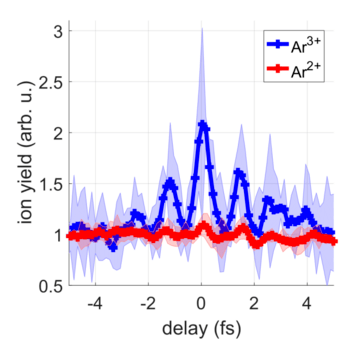
Fig. 2: Ar2+ and Ar3+ ion yields as a function of the time delay between two attosecond pulse trains. (a) The Ar2+ ion yield (red curve) is only weakly modulated as a function of the XUV-XUV time delay, whereas clear oscillations with a period of 1.3 fs are observed in the delay-dependent Ar3+ ion yield (blue curve). These results indicate that Ar2+ is generated via the sequential absorption of two photons. Subsequently, two additional photons are simultaneously absorbed to form Ar3+.
Honey, we shrunk the intense XUV laser

An international team of researchers has demonstrated a new concept for the generation of intense extreme-ultraviolet (XUV) radiation by high-harmonic generation (HHG). Its advantage lies in the fact that its footprint is much smaller than currently existing intense XUV lasers. The new scheme is straightforward and could be implemented in many laboratories worldwide, which may boost the research field of ultrafast XUV science. The detailed experimental and theoretical results have been published in Optica.

The invention of the laser has opened the era of nonlinear optics, which today plays an important role in many scientific, industrial and medical applications. These applications all benefit from the availability of compact lasers in the visible range of the electromagnetic spectrum. The situation is different at XUV wavelengths, where very large facilities (so called free-electron lasers) have been built to generate intense XUV pulses. One example of these is FLASH in Hamburg that extends over several hundred meters. Smaller intense XUV sources based on HHG have also been developed. However, these sources still have a footprint of tens of meters, and have so far only been demonstrated at a few universities and research institutes worldwide.

A team of researchers from the Max Born Institute (Berlin, Germany), ELI-ALPS (Szeged, Hungary) and INCDTIM (Cluj-Napoca, Romania) has recently developed a new scheme for the generation of intense XUV pulses. Their concept is based on HHG, which relies on focusing a near-infrared (NIR) laser pulse into a gas target. As a result, very short light bursts with frequencies that are harmonics of the NIR driving laser are emitted, which thereby are typically in the XUV region. To be able to obtain intense XUV pulses, it is important to generate as much XUV light as possible. This is typically achieved by generating a very large focus of the NIR driving laser, which requires a large laboratory.

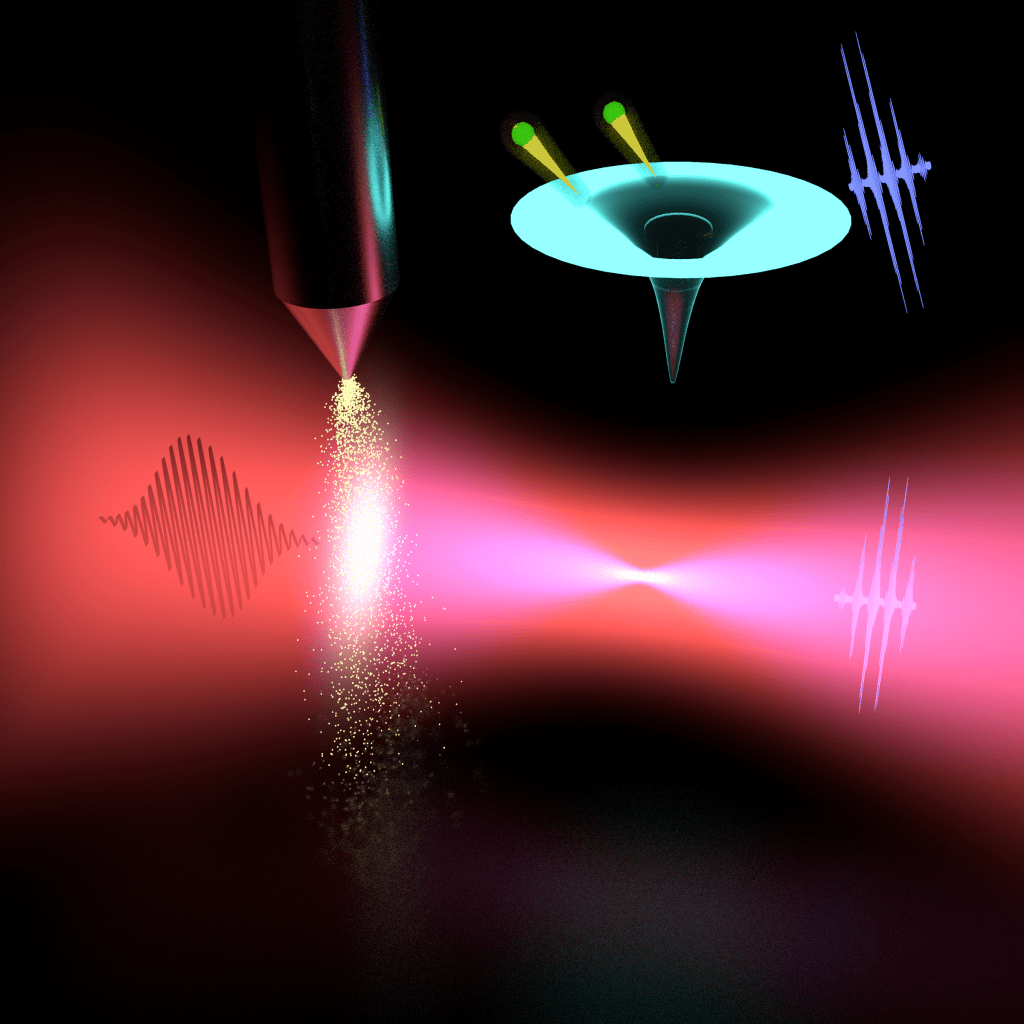
Scientists from the Max Born Institute have demonstrated that it is possible to shrink an intense XUV laser by using a setup which extends over a length of only two meters. To be able to do so, they used the following trick: Instead of generating XUV light at the focus of the NIR driving laser, they placed a very dense jet of atoms relatively far away from the NIR laser focus, as shown in Fig. 1. This has two important advantages: (1) Since the NIR beam at the position of the jet is large, many XUV photons are generated. (2) The generated XUV beam is large and has a large divergence, and can therefore be focused to a small spot size. The large number of XUV photons in combination with the small XUV spot size makes it possible to generate intense XUV laser pulses. These results were confirmed by computer simulations that were carried out by a team of researchers from ELI-ALPS and INCDTIM.

To demonstrate that the generated XUV pulses are very intense, the scientists studied multi-photon ionization of argon atoms. They were able to multiply ionize these atoms, leading to ion charge states of Ar2+ and Ar3+. This requires the absorption of at least two and four XUV photons, respectively. In spite of the small footprint of this intense XUV source, the obtained XUV intensity of 2 x 10¹⁴ W/cm2 exceeds that of many already existing intense XUV sources.

The new concept can be implemented in many laboratories worldwide, and various areas of research may benefit. This includes attosecond-pump attosecond-probe spectroscopy, which has so far been extremely difficult to do. The new compact intense XUV laser could overcome the stability limitations that exist within this technique, and could be used to observe electron dynamics on extremely short timescales. Another area that is expected to benefit is the imaging of nanoscale objects such as bio-molecules. This could improve the possibilities for making movies in the nano-cosmos on femtosecond or even attosecond timescales.

Compact intense XUV source. An NIR pulse (red) is focused, and high harmonics are generated in a gas jet that is placed before or behind the NIR focus. In this way, the generated XUV light has a size and a divergence that is similar to the that of the NIR beam. Due to the shorter wavelength, the focus of the XUV beam is then much smaller than the focus of the NIR beam. This allows the generation of intense XUV pulses which are used for XUV multi-photon ionization of atoms (see upper part). Image credit: Balázs Major

Compact intense extreme-ultraviolet source

B. Major, O. Ghafur, K. Kovács, K. Varjú, V. Tosa, M. J. J. Vrakking and B. Schütte

Optica 8, 960 (2021).

White turns into (extreme-)ultraviolet

Researchers from the Max Born Institute for Nonlinear Optics and Short Pulse Spectroscopy (MBI) have developed a new method to modify the spectral width of extreme-ultraviolet (XUV) light. By employing a novel phase-matching scheme in four-wave mixing, they could compress the spectral width of the initial broadband  light by more than hundred times. The detailed experimental and theoretical results have been published in Nature Photonics.

Light, as emitted by the sun, consists of many different colors and typically appears as white. Sometimes, however, only certain colors reach our eyes, leading to stunning phenomena like an afterglow. For technical or scientific applications that require a specific color, gratings and prisms can be used to extract this color from the white light. However, most of the incoming light is lost during this process, and the light intensity at the exit is very low. 

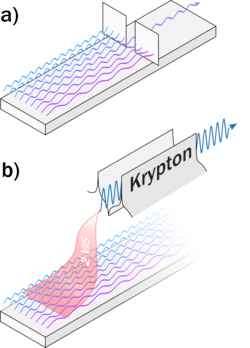
Nonlinear optical techniques have made it possible to change the color of light and modify its spectral bandwidth without compromising the intensity. As illustrated in Fig. 1, this enables the generation of light with a specific color from broadband light (such as white light) or vice versa. These techniques are widely applied in spectroscopy, imaging, and for the generation of ultrashort laser pulses. However, nonlinear optical techniques are not readily available in the XUV region of the electromagnetic spectrum. This region is of increasing interest for various applications, including attosecond science and EUV lithography.

A team of researchers from the Max Born Institute has recently demonstrated a new concept to generate narrowband laser pulses in the XUV range. They combined broadband white light in the visible region with light having a broad spectrum in the vacuum-ultraviolet (VUV) region. After both of these light pulses simultaneously propagated through a dense jet of krypton atoms, a new laser pulse in the XUV range was generated. Remarkably, the spectral width of the new XUV pulse was more than hundred times narrower compared to the initial visible and VUV pulses.

The scientists employed a scheme known as four-wave mixing, where one krypton atom absorbs two visible photons and one VUV photon, leading to the emission of one XUV photon. Due to energy conservation, the emitted XUV photon must have a frequency equal to the sum of the frequencies of all three absorbed photons. At the same time, due to momentum conservation, the velocity of the incoming light wave has to match the velocity of the outgoing wave inside the mixing medium. This velocity changes very fast close to an atomic resonance.

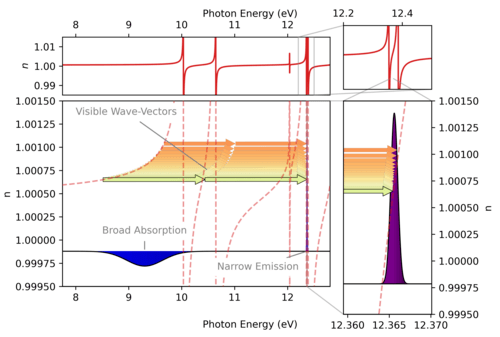
To generate the narrowband XUV laser band, the researchers chose a VUV spectral range quite far away from any resonance and a target XUV range between two resonances. In doing so, they were able to match the velocities of a broad range of incoming wavelengths to a narrow region of outgoing wavelengths. In Fig. 2, on the left side, absorption in the VUV over a broad spectral range (blue area) is indicated. The red dashed curve indicates the frequency-dependent refractive index, which is a measure of the light velocity. On the right side, a narrow spectral region in the XUV range (violet area) is shown. In these regions, the light travels approximately at the same speed, i.e., with a similar refractive index. These velocities can be matched by the near-horizontal arrows indicating the photons in the visible spectrum. The illustration shows that this allows converting a broadband VUV spectrum with a relatively flat wavelength-velocity dependence into a narrowband XUV pulse, where the wavelength-velocity dependence is near vertical.

The generation of narrowband XUV pulses is interesting for applications such as electron spectroscopy, the investigation of resonant transitions, and the coherent diffractive imaging of nanoscale structures. In the future, the new method could also be used in the opposite direction, i.e., to spectrally broaden XUV pulses, which may result in the generation of very short XUV pulses from sources such as free-electron lasers and soft- X-ray lasers.

Link to publication

Fig. 1:  Concepts for the generation of a specific color. (a) A specific color can be selected from a broadband light source using e.g. a prism or a grating. This comes, however, at the expense of losing most of the light. (b) By applying a nonlinear optical technique such as four-wave mixing in krypton, it is possible to generate a specific color using all the available light at different colors.

Fig. 2: XUV spectral compression scheme: The refractive index as a function of the photon energy is shown by the red dashed curve. In the region around 9.2 eV it changes comparably slowly (left side), whereas it changes very fast in the region around 12.365 eV. Therefore, a broadband absorption (blue area) can lead to a narrowband emission (violet area) with the help of two visible photons (shown by the arrows).

Atomic jet – the first lens for extreme-ultraviolet light developed

Scientists from the Max Born Institute (MBI) have developed the first refractive lens that focuses extreme ultraviolet beams. Instead of using a glass lens, which is non-transparent in the extreme-ultraviolet region, the researchers have demonstrated a lens that is formed by a jet of atoms. The results, which provide novel opportunities for the imaging of biological samples on the shortest timescales, were published in Nature.

A tree trunk partly submerged in water appears to be bent. Since hundreds of years people know that this is caused by refraction, i.e. the light changes its direction when traveling from one medium (water) to another (air) at an angle. Refraction is also the underlying physical principle behind lenses which play an indispensable role in everyday life: They are a part of the human eye, they are used as glasses, contact lenses, as camera objectives and for controlling laser beams.

Following the discovery of new regions of the electromagnetic spectrum such as ultraviolet (UV) and X-ray radiation, refractive lenses were developed that are specifically adapted to these spectral regions. Electromagnetic radiation in the extreme-ultraviolet (XUV) region is, however, somewhat special. It occupies the wavelength range between the UV and X-ray domains, but unlike the two latter types of radiation, it can only travel in vacuum or strongly rarefied gases. Nowadays XUV beams are widely used in semiconductor lithography as well as in fundamental research to understand and control the structure and dynamics of matter. They enable the generation of the shortest human made light pulses with attosecond durations (an attosecond is one billionth of a billionth of a second). However, in spite of the large number of XUV sources and applications, no XUV lenses have existed up to now. The reason is that XUV radiation is strongly absorbed by any solid or liquid material and simply cannot pass through conventional lenses.

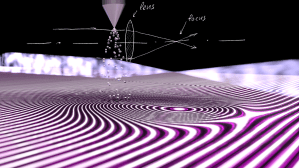
In order to focus XUV beams, a team of MBI researchers have taken a different approach: They replaced a glass lens with that formed by a jet of atoms of a noble gas, helium (see Fig. 1). This lens benefits from the high transmission of helium in the XUV spectral range and at the same time can be precisely controlled by changing the density of the gas in the jet. This is important in order to tune the focal length and minimize the spot sizes of the focused XUV beams.

In comparison to curved mirrors that are often used to focus XUV radiation, these gaseous refractive lenses have a number of advantages: A ‘new’ lens is constantly generated through the flow of atoms in the jet, meaning that problems with damages are avoided. Furthermore, a gas lens results in virtually no loss of XUV radiation compared to a typical mirror. “This is a major improvement, because the generation of XUV beams is complex and often very expensive,” Dr. Bernd Schütte, MBI scientist and corresponding author of the publication, explains.

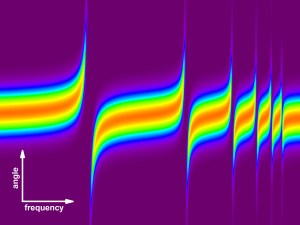
In the work the researchers have further demonstrated that an atomic jet can act as a prism breaking the XUV radiation into its constituent spectral components (see Fig. 2). This can be compared to the observation of a rainbow, resulting from the breaking of the Sun light into its spectral colors by water droplets, except that the ‘colors’ of the XUV light are not visible to a human eye.

The development of the gas-phase lenses and prisms in the XUV region makes it possible to transfer optical techniques that are based on refraction and that are widely used in the visible and infrared part of the electromagnetic spectrum, to the XUV domain. Gas lenses could e.g. be exploited to develop an XUV microscope or to focus XUV beams to nanometer spot sizes. This may be applied in the future, for instance, to observe structural changes of biomolecules on the shortest timescales.

Fig. 1: Focusing of an XUV beam by a jet of atoms that is used as a lens.

Fig. 2: Invisible rainbow that is generated by a jet of helium atoms. Light with ‘colors’ close to resonances of helium are either deflected upwards or downwards.

Original publication:
“Extreme-ultraviolet refractive optics

Lorenz Drescher, Oleg Kornilov, Tobias Witting, Geert Reitsma, Nils Monserud, Arnaud Rouzée, Jochen Mikosch, Marc Vrakking & Bernd Schütte
Nature
doi.org/10.1038/s41586-018-0737-3


Slow, but efficient: Low-energy electron emission from intense laser cluster interactions

When a nanoscale particle is exposed to an intense laser pulse, it transforms into a nanoplasma that expands extremely fast, and several phenomena occur that are both fascinating and important for applications. Examples are the generation of energetic electrons, ions and neutral atoms, the efficient production of X-ray radiation as well as nuclear fusion. While these observations are comparably well understood, another observation, namely the generation of highly charged ions, has so far posed a riddle to researchers. The reason is that models predicted very efficient recombination of electrons and ions in the nanoplasma, thereby drastically reducing the charges of the ions.

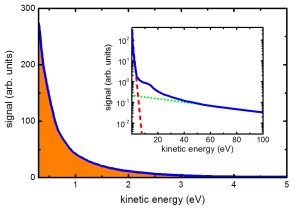
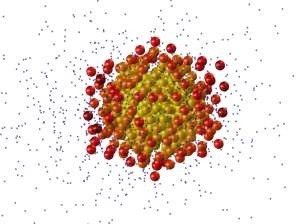
In a paper that was published in the current issue of Physical Review Letters, a team of researchers from the Imperial College London, the University of Rostock, the Max-Born-Institute, the University of Heidelberg and ELI-ALPS have now helped to solve this riddle. Tiny clusters consisting of a few thousand atoms were exposed to ultrashort, intense laser pulses. The researchers found that the vast majority of the emitted electrons were very slow (see Fig. 1). Moreover, it turned out that these low-energy electrons were emitted with a delay compared to the energetic electrons.

Lead scientist Dr. Bernd Schütte, who performed the experiments at Imperial College in the framework of a research fellowship and who now works at the Max-Born-Institute, says: “Many factors including the Earth’s magnetic field influence the movement of slow electrons, making their detection very difficult and explaining why they have not been observed earlier. Our observations were independent from the specific cluster and laser parameters used, and they help us to understand the complex processes evolving on the nanoscale.”

In order to understand the experimental observations, researchers around Professor Thomas Fennel from the University of Rostock and the Max-Born-Institute simulated the interaction of the intense laser pulse with the cluster. “Our atomistic simulations showed that the slow electrons result from a two-step process, where the second step relies on a final kick that has so far escaped the researchers’ attention”, explains Fennel. First, the intense laser pulse detaches electrons from individual atoms. These electrons remain trapped in the cluster as they are strongly attracted by the ions. When this attraction diminishes as the particles move farther away from each other during cluster expansion, the scene is set for the important second step. Therein, weakly bound electrons collide with a highly excited ion and thus get a final kick that allows them to escape from the cluster. As such correlated processes are quite difficult to model, the computing resources from the North-German Supercomputing Alliance (HLRN) were essential to solve the puzzle.

The researchers found the emission of slow electrons to be a very efficient process, enabling a large number of slow electrons to escape from the cluster. As a consequence, it becomes much harder for highly charged ions to find partner electrons that they can recombine with, and many of them indeed remain in high charge states. The discovery of the so-called low-energy electron structure can thus help to explain the observation of highly charged ions from intense laser cluster interactions. These findings might be important as low-energy electrons are implicated as playing a major role in radiation damage of biomolecules – of which the clusters are a model.

Senior author Professor Jon Marangos, from the Department of Physics at Imperial, says: “Since the mid-1990’s we have worked on the energetic emission of particles (electrons and highly charged ions) from laser-irradiated atomic clusters. What is surprising is that until now the much lower energy delayed electron emission has been overlooked. It turns out that this is a very strong feature, accounting for the majority of emitted electrons. As such, it may play a big role when condensed matter or large molecules of any kind interact with a high intensity laser pulse.”

Fig. 1: The electron kinetic energy spectrum from argon clusters interacting with intense laser pulses is dominated by slow electrons (orange area). The inset shows the same spectrum on a logarithmic scale, indicating the slow electrons (indicated by the red curve) and the fast electrons (indicated by the green curve).


Fig. 2: Atomistic simulation of the laser-induced cluster explosion. Credit: Thomas Fennel


Original publication:

Physical Review Letters 121, 063202 (2018), doi: https://doi.org/10.1103/PhysRevLett.121.063202

Low-energy electron emission in the strong-field ionization of rare gas clusters”

Bernd Schütte, Christian Peltz, Dane R. Austin, Christian Strüber, Peng Ye, Arnaud Rouzée, Marc J. J. Vrakking, Nikolay Golubev, Alexander I. Kuleff, Thomas Fennel and Jon P. Marangos

Fast electrons at long wavelengths

Efficient electron acceleration was observed in clusters induced by a laser field at 1.8 μm that consisted of only two optical cycles. In this regime that is dominated by electronic rather than nuclear dynamics, clear signatures of direct electron emission were observed as well as rescattering of electrons that gain additional kinetic energy during laser-driven collisions with ions and with the cluster potential. The results, which were obtained at the Imperial College London, promise efficient particle acceleration in clusters at mid-infrared and terahertz wavelengths.

Link to publication

Bernd Schütte receives ISUILS award

Bernd Schütte has received the 7th ISUILS Award for Young Researchers. This prize is sponsored by the Japan Intense Light Field Science Society and was awarded at the 15th International Symposium on Ultrafast Intense Laser Science, currently taking place in Cassis in the South of France. Bernd Schütte has received this award for his work on ultrafast cluster dynamics during the past few years.

Workshop impressions

The second workshop on “Ultrafast Cluster Dynamics” took place from August 23-24 at the Max-Born-Institut, and was organized together with the TU Berlin. Our 40 guests presented 14 exciting posters and 9 talks, which resulted in many lively discussions. A lot of new fascinating results have been obtained since the last workshop that took place 2 years ago in Rostock. We are already looking forward to the next edition of this workshop taking place in Freiburg in 2 years!

SAMSUNG CSC


Summer Workshop “Ultrafast Cluster Dynamics”

The second summer workshop on “Ultrafast Cluster Dynamics” will take place on August 23-24 at the Max-Born-Institut. Following the first edition organized by Thomas Fennel in Rostock in 2014, this workshop will be organized by Bernd Schütte in collaboration with Daniela Rupp and Maria Krikunova from the TU Berlin. We expect about 45 participants from Germany, but also from abroad. In addition to 9 talks about nonlinear cluster dynamics, we will have 14 interesting poster presentations. Please contact the organizers for more information.

Programm_UltrafastClusterDynamics