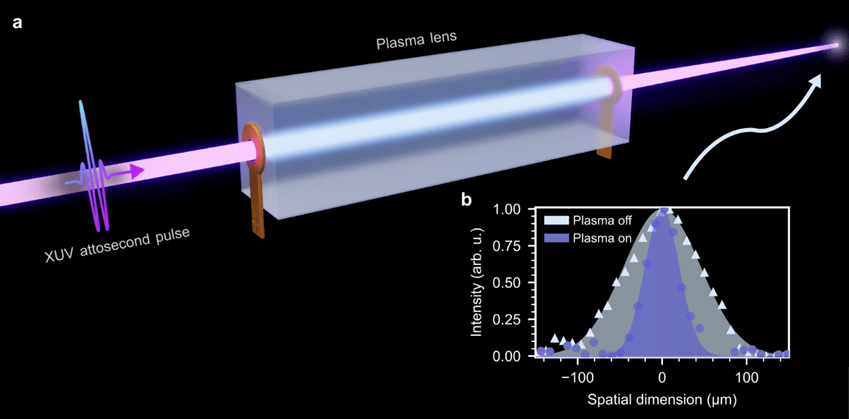
We have developed a table-top technique in which attosecond pulses both initiate and probe electronic motion. Using all-attosecond transient absorption spectroscopy, we resolved the oscillatory motion of an electron vacancy (an electronic “hole”) in xenon ions with a period of about three femtoseconds. The results have now been published in Nature Communications.
Electronic motion sets the stage for virtually every light-induced process in nature, from the first step of a chemical reaction to the flow of charge in a solid. Yet these processes unfold so rapidly that they can only be observed with flashes of light lasting a few hundred attoseconds – billionths of a billionth of a second. Most previous attosecond experiments combined an attosecond pulse in the extreme ultraviolet (XUV) with a longer and often intense near-infrared pulse. Such fields can disturb the system under investigation and obscure its intrinsic electronic response. In the new approach, both the pump and the probe are attosecond extreme-ultraviolet pulses, providing a potentially much cleaner view of the underlying dynamics.
We generated pulses with a duration of approximately 270 attoseconds using a laboratory-based high-harmonic source. A precision split-and-delay system produced two pulse replicas with an independently adjustable delay. The first pulse removed an electron from a xenon atom and created the ion in a coherent superposition of two closely spaced electronic states. The resulting electron vacancy, or “hole”, did not remain stationary but oscillated periodically within the ion.
The second attosecond pulse recorded this motion through changes in the extreme-ultraviolet absorption spectrum. The observed period of about three femtoseconds is consistent with the beating expected from the energy separation of the two spin-orbit states. “Using attosecond pulses in both steps allows us to initiate electronic motion and observe it without applying an additional strong infrared field,” explains Bernd Schütte, who led the study. “This brings us closer to watching electronic processes as they unfold, without significantly perturbing them.”
The experiment marks an important step toward a new generation of attosecond spectroscopy that can be carried out using table-top light sources. By combining extreme temporal resolution with the ability to distinguish individual electronic states, the method could make it possible to follow how charge moves through molecules, how electronic energy is redistributed, and how the first decisive steps of a photochemical reaction emerge from the coupled motion of electrons and nuclei.
The potential impact extends far beyond atoms and molecules. Applied to solids, the technique could reveal how electronic screening, scattering, carrier multiplication, exciton formation and charge transfer across interfaces develop on attosecond to femtosecond timescales. Such measurements could provide a new microscopic view of the processes that determine the performance of semiconductors, quantum materials, two-dimensional systems and future optoelectronic devices. In the long term, all-attosecond spectroscopy may offer a route towards observing – and ultimately controlling – the fastest electronic processes that govern how matter responds to light.
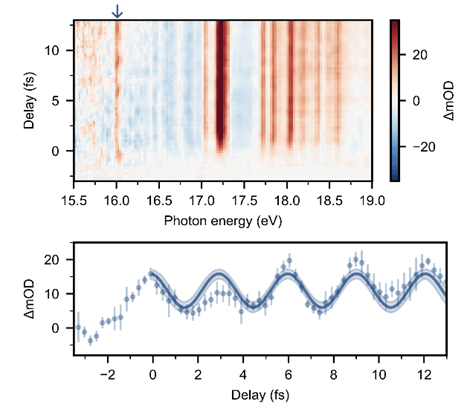
Fig. 1 | Observation of hole motion in Xe⁺ ions. The upper panel shows the delay-dependent change in XUV absorption; the arrow marks an oscillatory feature near 16 eV. The lower panel shows a lineout of this feature, revealing a period of about 3 fs.